
An industrial piping system is only as reliable as the connections that keep everything together. While pumps and pipes often take center stage, the flanged connectors between them play a critical role in ensuring safe, efficient, and leak-free operations. A well-designed pump connection minimizes turbulence and pressure drops by promoting consistent flow patterns. They also support the pipes on either side of a pump, which improves flow and prevents cavitation and vibration.
Connectors also maintain alignment of pipes and pump shafts. If they are off by as little as 0.005 in. or more vibration can increase. This reduces bearing life, and leads to premature equipment failure. Properly aligned connectors and flanges transfer energy consistently from the motor to the pump for reliable operations.
Here, we’ll look at the role these vital connections play in industrial pipelines and the major types, along with tips for maintenance and selecting the best connector for your application.
Benefits of Pump Connections in Industrial Systems
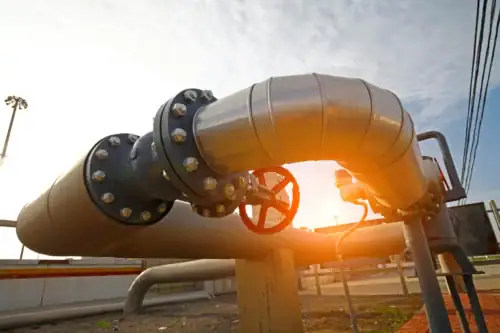
A primary benefit that pump connections offer is leak prevention. Well-sealed flange joints minimize the escape of liquid or gas, which protects personnel, equipment, and the environment. Leaks can also contribute to changes in pressure or flow rate, and they result in waste. Live-loaded flange designs can maintain sealing pressure during thermal expansion and contraction, which is especially important in systems with temperature fluctuations.
Another advantage is the structural integrity that flange connections provide. Threaded, bolted, or welded flange connections are highly secure and strong. These joints can handle high pressures and corrosive media, making them indispensable for industries such as oil and gas, chemical processing, and water treatment.
In some applications, bolted or threaded flange connections are beneficial because they enable quick disassembly and reassembly. This reduces downtime during repairs or upgrades and simplifies system reconfiguration. This is a clear advantage over permanent welded joints for some situations.
Flange design also plays a crucial role in vibration control. By maintaining tight sealing and alignment, flanges help stabilize the entire piping system. As a result, systems experience fewer failures, less wear on gaskets and seals, and better long-term performance.
Key Types of Pump Connections
There are many flange types available depending on the application and fluid media being transported. They include:
- Weld-neck Flanges. These are particularly robust and feature a long, tapered hub that transitions smoothly into the pipe. This type of flange offers superior strength and reduced stress concentration. It’s best suited for high-pressure and high-temperature applications.
- Slip-on Flanges. These flanges are easier and more economical to install than some other options. The pipe is inserted into the flange and fillet-welded on both sides. Though not as strong as weld-neck designs, they’re sufficient for lower-pressure environments and general service applications.
- Blind Flanges. These are generally used to seal the end of a piping system. They are most useful during pressure testing or when future system expansions are expected.
- Lap Joint Flanges. These slide over the end of a pipe and are usually used in conjunction with stub end fittings. In most configurations, the pipe is welded to the stub end fitting so the lap joint flange can rotate freely around it. They are well-suited to applications that are disassembled often.
- Threaded Pipe Flanges. These flanges are used with externally-threaded pipes, and they feature tapered threads on the inside of the flange. They can be attached without welding and are suitable for small-diameter, high pressure systems.
- Socket-weld Pipe Flanges. These attach by inserting the pipe into the socket end of the flange and fillet welding around the top. They have a smooth bore that facilitates fluid flow, and are often used on small-diameter, high-pressure configurations.
How to Maintain Pump Connection Flanges
As with other pipeline components, routine inspection and maintenance is essential to avoid damage, waste, and unplanned pipeline interruptions. Start by inspecting bolt torque. Inadequate or excessive torque can cause leaks or blowouts, especially in high-stress systems. You also need to regularly monitor gasket performance. Elastomeric gaskets, for example, degrade over time when exposed to heat or aggressive chemicals, so they should be replaced as part of scheduled maintenance.
Flange face inspection is also critical. Look for signs of pitting, corrosion, or misalignment, which are all issues that compromise seal integrity. Misalignment greater than 0.005 in. is a red flag and can lead to leaks, increased vibration, or equipment damage. Following a preventive maintenance checklist that includes regular visual inspections and torque audits can extend the lifespan of both the flange and the system as a whole.
Comparing Pump Connection Types for System Optimization
Each type of flange has strengths that make them suitable for certain uses, and they are often not interchangeable. For example, while weld-neck flanges offer superior durability and pressure resistance, they also require precise welding and alignment, which can make them more expensive to install than other options. However, because they are ideal for long-term or mission-critical applications, they may be the only choice in many cases.
Slip-on flanges are quicker to install, but they are less suitable for systems that have frequent thermal cycling or high vibration. Lap joint flanges strike a balance by allowing easier bolt-hole alignment and disassembly. These are especially effective in corrosive environments, where a corrosion-resistant stub end and reusable backing flange can be used.
Blind flanges offer flexibility for system expansion and testing. They are best-suited for sealing off the ends of piping sections, which makes them essential in modular or staged system designs.
Choosing the Right Pump Connection for Your Application
Selecting the right type of industrial flange for an application begins with evaluating the operational demands of your system. High-pressure environments often require weld-neck flanges, which can handle pressures up to 5,000 psi and offer robust performance under stress. Their tapered design ensures even stress distribution, which reduces the risk of flange failure during thermal or mechanical loads.
For systems with lower pressures or non-critical applications, slip-on flanges can be a cost-effective choice. They perform well up to ANSI Class 300 pressure ratings. Lap joint flanges are preferred in corrosive environments because they allow for localized use of corrosion-resistant materials only at the flange face, while incorporating more economical materials for the backing flange.
Partnering with an experienced flange manufacturer, like Coastal Flange, is the best way to make sure you select the optimal flange type and material for your application.
Pump Connections from Coastal Flange
Whether you need weld-neck flanges for high-pressure operations or slip-on flanges for general service, Coastal Flange delivers precision-engineered solutions for every application.
To explore the full range of options or discuss a specific project, contact us today. Our team is ready to assist you in finding the ideal flange connection for your system.