
When comparing a lap joint flange vs slip-on flange, engineers must evaluate how each design affects installation, cost, and long-term performance. Factors such as corrosion resistance, pressure rating, welding requirements, and maintenance access all influence which flange type is best suited for a given system.
Understanding the differences between a lap joint vs slip-on flange helps engineers and procurement teams select components that meet both technical requirements and lifecycle cost expectations.
What is a Lap Joint Flange?
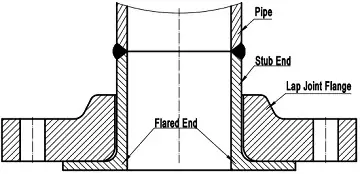
A lap joint flange is a two-piece assembly that works with a stub end. The flange itself does not contact the process media; instead, it sits behind the stub end, which provides the sealing surface.
Key characteristics of lap joint pipe flanges include:
- Two-piece assembly consisting of a backing flange and stub end
- Rotational freedom for easier bolt-hole alignment
- Separation between structural material and wetted material
Lap joint pipe flanges are commonly used in lined, clad, or high-alloy piping systems. Because only the stub end contacts the process media, engineers can selectively specify corrosion-resistant alloys, reducing material costs without compromising performance.
What Is a Slip-On Flange?
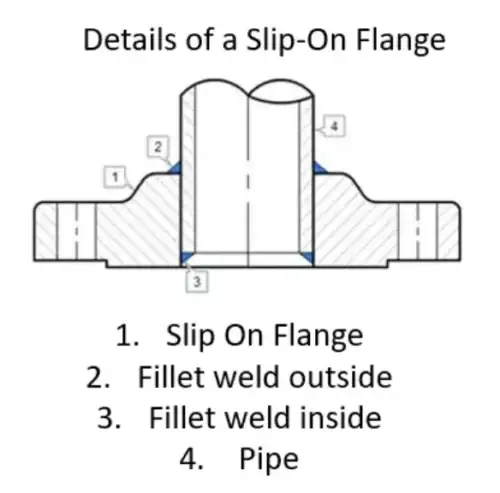
A slip-on flange is installed by sliding over the pipe’s outside diameter and securing it with two fillet welds, one internal and one external. The pipe fits into the flange bore with controlled clearance before welding.
Slip-on flanges are commonly selected due to the following characteristics:
- Single-piece flange design
- Dual fillet weld attachment
- Easier alignment compared to butt-weld connections
- Simplified fabrication and installation
Their simplicity allows slip-on flanges to be used more widely in moderate-pressure service applications — yet their weld geometry does not provide full-penetration reinforcement, as with weld-neck flanges. However, because slip-on flanges rely on fillet welds rather than full-penetration welds, they are generally limited to moderate-pressure applications where maximum strength is not required.
Key Considerations Between Lap Joint Flanges and Slip-On Flanges
When evaluating a lap joint flange vs slip-on flange, several key factors influence selection, including installation requirements, material strategy, and end-use application.
Installation & Cost
The installation method directly impacts both upfront costs and long-term maintenance requirements. The installation method directly affects project economics in several ways:
- Lap joint flanges:
- Allow flange rotation for easier alignment and maintenance
- Require additional components (stub ends), increasing initial material cost
- Reduce alloy costs in corrosive environments
- Slip-on flanges:
- Lower initial unit cost
- Require two fillet welds per connection
- May increase inspection and welding labor requirements
Lap joint systems can reduce downtime in maintenance-heavy environments, as joints can be disassembled without rotating the pipe.
Material Grades
Material selection plays a critical role when comparing lap joint vs slip-on flange configurations, particularly in corrosive or high-temperature environments.
- Lap joint flanges:
- Support mixed metallurgy (e.g., stainless steel stub end with carbon steel backing flange)
- Suitable for corrosive, lined, or high-alloy systems
- Slip-on flanges:
- Typically match the pipe material
- Common in carbon steel systems, especially in waterworks applications
Applications
End-use application is often the deciding factor when selecting between flange types, particularly in oil and gas and waterworks systems.
- Oil & Gas:
- Corrosive service lines benefit from alloy stub ends
- Systems requiring frequent disassembly favor lap joint flanges
- Utility or moderate-pressure lines may use slip-on flanges for cost efficiency
- Waterworks:
- Municipal piping commonly uses slip-on flanges in carbon steel systems
- Chemically treated or corrosive water systems may require lap joint assemblies
In all cases, compliance with ASME dimensional standards and pressure class requirements is critical when specifying flange types.
Selecting the Right Flange for Your Application
Selecting the right flange requires evaluating pressure ratings, material compatibility, corrosion exposure, and installation requirements. These factors directly impact system performance, maintenance needs, and total lifecycle cost.
Coastal Flange manufactures both lap-joint and slip-on pipe flanges, with a focus on quality, custom sizing, and fast turnaround. With facilities located in Houston, Texas, we support oil and gas and waterworks projects with reliable delivery and application-specific expertise. Contact our team to request a quote or discuss your project requirements.